
Base camp: how to write an intended purpose that holds all the way to the summit
 Written by Niko Mangold
Last reviewed:
A field guide for MedTech founders on the one paragraph that decides your device class, your evidence, and your route to market.
The most expensive regulatory decision is usually made in the first month
Many projects that stall in front of a Notified Body were set on that course long before, by one paragraph nobody thought much about at the time.
Your prototype works on real patients. A pilot clinic wants to keep using it. The investor deck says "CE marking in twelve months", and the timeline looked reasonable when you drew it.
Then somebody asks what exactly the device is for. Who uses it, on which patients, to make which decision. You answer the way you answer on a sales call, broadly and with ambition, because broad sounds like a bigger market.
Eighteen months later that answer comes back. It decided your device class. The class decided how much clinical evidence you need, which conformity route you take, and how deep the Notified Body review goes. A Notified Body is the independent organisation that has to assess your file before you may sell any device above class I, and some class I devices, in Europe. It reads every page of that file against the sentence you wrote in month one.
That sentence is your intended purpose. This guide is about getting it right first, while it is still cheap to change.
Getting to market is a climb in four stages, and the route is fixed at base camp
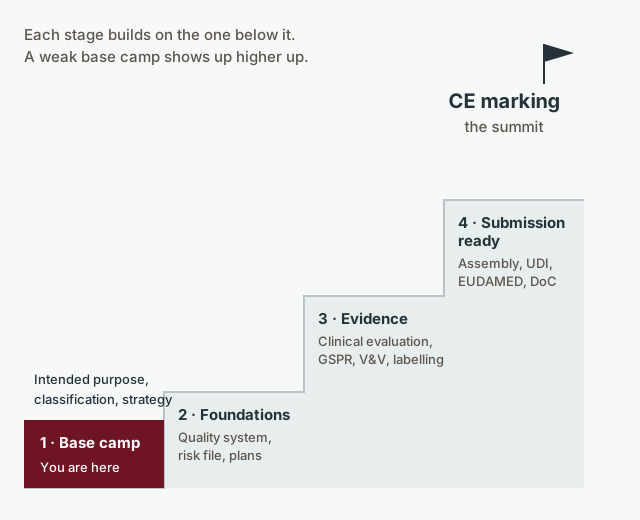
Under the EU Medical Device Regulation (MDR, Regulation (EU) 2017/745), the summit is the CE marking. Each stage builds on the one below it, so a weak base camp shows up much higher on the mountain.
| Stage | What gets settled |
|---|---|
| 1 · Base camp | What the device is and what that obliges you to do: intended purpose, qualification as a device, classification, and the regulatory strategy. |
| 2 · Foundations | The quality management system and the safety spine: risk management file, clinical evaluation plan, design and development plan, and post-market surveillance plan. |
| 3 · Evidence | The reports that prove it: clinical evaluation report, the checklist of general safety and performance requirements (GSPR), verification and validation, and labelling. |
| 4 · Submission ready | Assembly, cross-checks, the Notified Body application pack where one is involved, UDI (unique device identification) and EUDAMED registration, and the declaration of conformity. |
This guide covers the MDR. Products that examine specimens from the human body fall under the In Vitro Diagnostic Regulation (IVDR, Regulation (EU) 2017/746), with classes A to D; the intended purpose logic is the same.
Four decisions, and the intended purpose comes first because the other three are read from it
Qualification, classification, and the conformity route all depend on what you say the device is for. Change that paragraph and every one of them can move.
- Intended purpose. The use you, the manufacturer, say the device is for. Defined in MDR Article 2(12).
- Qualification. Whether the product is a medical device at all, judged by its medical purpose under MDR Article 2(1).
- Classification. Class I to III, by the 22 rules of MDR Annex VIII, applied according to the intended purpose (§3.1).
- Conformity route. How conformity is assessed and whether a Notified Body is involved, set out in MDR Article 52.
What else hangs off that one paragraph
| Part of your file | Why it depends on the intended purpose |
|---|---|
| Clinical evaluation | You must show clinical evidence for every indication and population you claim (MDR Article 61). Each one you add is evidence you owe. |
| Risk management | Risks are assessed for the intended use and foreseeable misuse (MDR Annex I §3(c)). A vague use makes that list endless. |
| Instructions for use | The instructions must state the intended purpose with indications, contra-indications, patient groups, and intended users (MDR Annex I §23.4(b)). |
| Usability | Design must consider the users and use environment (MDR Annex I §5). A patient at home is not a radiologist. |
| Marketing and sales | Advertising may not suggest uses outside the intended purpose that was assessed (MDR Article 7(d)). It is the boundary of what you may say. |
Your intended purpose is everything you say about your device, including on your website
Most founders think of the intended purpose as a paragraph in the technical file. The definition in the MDR is considerably wider.
MDR Article 2(12): "'intended purpose' means the use for which a device is intended according to the data supplied by the manufacturer on the label, in the instructions for use or in promotional or sales materials or statements and as specified by the manufacturer in the clinical evaluation"
Read the middle of that sentence again: promotional or sales materials or statements. Your product page, the brochure you send a hospital buyer, a sales email, and a post that says your algorithm "detects" something all tell an auditor what you believe the device is for.
That is why the intended purpose is a strategic document as much as a regulatory one. It is the point where your regulatory team and your marketing team have to agree, in writing, before either of them publishes anything.
There is a second consequence. Article 7 forbids labelling and advertising that could mislead users or patients about the intended purpose, safety, or performance of a device, including by ascribing functions it does not have. A website that promises more than your file supports is a finding waiting to be written.
A tip from base camp. Write the intended purpose first and the marketing copy second. When the order runs the other way round, the website tends to promise a detection feature, and a software product drafted as class I ends up being assessed as class IIa.
Seven building blocks a reviewer expects to find, and where the MDR asks for them
An intended purpose that holds answers each of these explicitly. If a reviewer has to infer one, assume they will infer the broadest reading.
| Building block | The question it answers | Basis |
|---|---|---|
| Medical purpose | What does it do for health: diagnose, monitor, predict, treat, or support a decision? Choose the verb with care, because the verb drives the class. | Art. 2(1), Art. 2(12) |
| Condition and indication | Which disease, injury, or condition, and at which point in the care pathway? | Annex II §1.1(c) |
| Patient population | Adults or children, which severity, any selection criteria? Every population you name needs clinical evidence behind it. | Annex II §1.1(c) |
| Intended users | Specialist clinician, nurse, carer, or the patient as a lay user? Who reads the output and acts on it? | Annex II §1.1(a), Annex I §23.4(b) |
| Use environment | Hospital ward, intensive care, general practice, or home use? | Annex I §5 |
| Principle of operation | How it achieves its purpose, in plain language. For software: which inputs, which outputs, and how the output is presented. | Annex II §1.1(d) |
| Contra-indications and limits | Who and what it is not for. Exclusions narrow the evidence you owe and make the device safer to use. | Annex II §1.1(c), Annex I §23.4(b) |
Keep it beside the paragraph. Write down the clinical benefit you expect too: the measurable, patient-relevant outcome the device should deliver (MDR Article 2(53)). It belongs in the clinical evaluation, and it keeps the intended purpose honest, because a purpose with no measurable benefit is usually a purpose that is still too vague.
One verb can take the same software from outside the MDR to class III
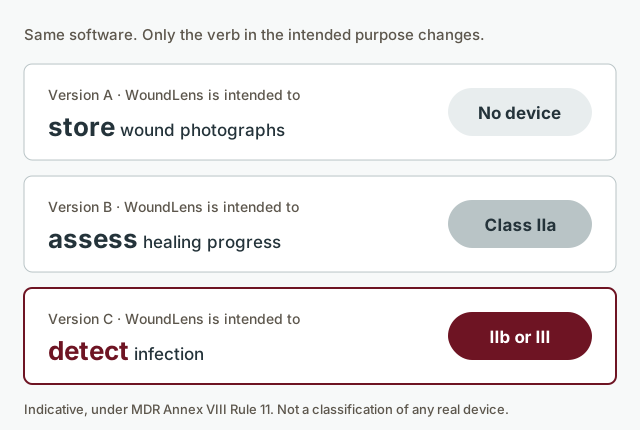
WoundLens is a fictional app that photographs chronic wounds with a smartphone. The technology is identical in all three versions below. Only the intended purpose changes.
| Version | Intended purpose | Likely outcome |
|---|---|---|
| A | WoundLens is intended for nurses to photograph chronic wounds and store the images in the patient record. | No device likely: storing and sharing images without analysis has no medical purpose |
| B | WoundLens is intended for nurses to assess healing progress of chronic wounds and support decisions on changing the wound treatment. | Class IIa: information used for therapeutic decisions, Rule 11; IIb if a wrong decision could cause serious deterioration |
| C | WoundLens is intended to detect signs of infection in diabetic foot ulcers and guide the decision to start antibiotic treatment. | IIb or III: a missed infection can lead to surgery (IIb) or to amputation or sepsis (III), Rule 11 |
What the move from A to C costs. Adding a single measurement to Version A already makes it a class IIa device. Each step up the classes means more clinical evidence, a deeper Notified Body review, and more post-market obligations. Version C also has to prove its detection performance in the intended population, which for a new algorithm usually means a clinical investigation (MDR Article 62), because published literature alone will rarely carry it. If the detection is AI-based, the EU AI Act treats it as high-risk, with obligations from 2 August 2028.
None of the three versions is wrong. Version C may be the one your investors and clinicians actually want, and its exclusions decide its class: limited to mild and moderate infections, as an adjunct to clinical assessment, it has a IIb argument. The mistake is choosing it by accident, through a word on a slide, without the evidence plan and budget that come with it.
The classes shown illustrate how MDR Annex VIII Rule 11 reads an intended purpose. They are indicative and not a classification of any real device. A real classification walks every applicable rule against the full file. Guidance: MDCG 2019-11. AI Act dates are subject to the EU Digital Omnibus.
Two real devices where a rewritten intended purpose changed the class
WoundLens is invented. These two are not. Both come from projects Niko has worked on, anonymised.
Planned as class IIa. Version one: not a medical device.
Version 1: no medical device → later version: class I → further version: class IIa.
The team had budgeted for a class IIa device. Rewriting the intended purpose showed that the first version had no medical purpose at all, so it needed no CE marking. The medical functions moved onto the roadmap, to arrive as a class I version and then a class IIa version, each when its evidence is ready. The company saved a substantial amount of money at the point where money is scarcest.
Described as class IIa. Described correctly: class I.
First description: class IIa → correct description: class I.
The first description claimed more than the device does. Once the intended purpose said exactly what the device does, and nothing more, the classification rules placed it in class I.
Both rewrites worked because the new wording was true. Narrowing the words without narrowing the product is the mistake the template section below warns about, and a reviewer will find it.
Five ways an intended purpose breaks, and how to spot each one in your own draft
We see these in first drafts again and again. All five are easy to fix at base camp and expensive to fix once a Notified Body has written them up.
- The ambition statement. "Improves outcomes for patients with chronic disease" names no condition, no user, and no decision. A reviewer cannot classify it, so they will read it in the broadest way available to them.
- The marketing drift. The file says "supports documentation", while the website says "detects early signs". Under Article 2(12) both count, and the reviewer will notice the gap long before you do.
- The missing user. Leaving the user open invites a reviewer to read lay users in, and devices for lay persons carry their own requirements (MDR Annex I §22) for usability, labelling, and risk.
- The silent contra-indication. Without exclusions, a reviewer can ask for evidence covering children, pregnancy, and every severity. Naming what the device is not for is one of the cheapest risk controls available.
- The roadmap leaking in. Version three features written into a version one purpose raise the class before the product can do the job. Start narrow, but plan it: widening the purpose later needs your Notified Body's approval before you can claim it (MDR Annex IX §4.10), and it may move the class.
Twelve questions to ask of your draft before you show it to anyone
If you cannot tick a box, the paragraph is not finished yet. Work through it with whoever writes your website copy.
- The medical purpose uses one precise verb, and I know which classification rule that verb triggers.
- The condition or indication is named, including the point in the care pathway.
- The patient population is defined by age, severity, and any selection criteria.
- The intended user is named, and I know whether a lay user is included.
- The use environment is stated: hospital, practice, home, or a combination.
- The principle of operation is described in plain language, with inputs and outputs.
- Contra-indications and exclusions are listed, or I have consciously decided there are none.
- I can name the clinical benefit and say how it would be measured.
- Every population and indication I claim is one I can support with clinical evidence.
- Our website, sales materials, and pitch to buyers claim nothing the paragraph does not.
- The class this purpose implies matches the budget and timeline we have committed to.
- A second person, ideally someone who has read the classification rules, has challenged the draft.
Fill the blanks, then cross out every word you cannot defend
This structure covers the seven building blocks in five sentences. It gives you a disciplined first draft that you will still have to sharpen against your own device.
[Device name] is a [type of device or software] intended to [one precise verb] [condition or indication] in [patient population]. It achieves this by [principle of operation: inputs, processing, outputs]. It is intended to be used by [intended users] in [use environment]. The output is used to [the decision it informs, and who takes it]. It is not intended for [contra-indications, excluded populations, excluded uses].
Pick the verb last. Write everything else first, then choose the weakest verb that is still true. Supporting a decision and making it are different claims, and under MDCG 2019-11 they can land in different classes. The verb must describe what the software actually does: a reviewer classifies the function, not the adjective, and a disputed classification goes to the competent authority (MDR Article 51(2)).
Write the exclusions as carefully as the inclusions. A population you exclude is evidence you do not have to generate now.
Read it aloud to your head of marketing. If they want to change a word for the website, change it here first and see what happens to the class.
What a reviewer reads first. The verb, the user, and the exclusions. If those three are precise, the rest of the paragraph usually follows. If they are vague, no amount of detail elsewhere will save it.
From base camp to the summit, with senior experts who have made this climb before
Venitara pairs senior regulatory experts with regulatory AI. The experts own the judgement, and the AI does the groundwork so their time goes where it matters.

Vera stands for the senior regulatory experts who review, challenge, and attest your documents. She is an illustration and not a member of staff; the experts she stands for are real, and every attestation names the expert who reviewed it. VI is the AI inside the platform. It maps the pathway and flags gaps and missing evidence. VI shows where the work is and does not make regulatory judgements.
| Level | Marker | What it is |
|---|---|---|
| Explore | AI-generated, not validated | Free. The MedTech Compass and the first tools give you an indicative picture of your device class and gaps in minutes. Not suitable for submission. |
| Attest | Expert-reviewed | A named senior expert reads one document, for example your intended purpose, challenges it, and attests that it is ready for submission. |
| Certify | Human-led | The complete file and the system behind it are assessed for submission readiness. Conformity itself is only ever assessed by your Notified Body. |
Our team has delivered more than 40 regulatory projects. We cannot promise you an approval, and nobody honestly can. What we can do is help you arrive with a submission-ready file and the right Notified Body, which materially improves your chances and your speed.
The Venitara Attestation is an independent submission-readiness attestation, not a Notified Body endorsement or a guarantee of approval.
You have read the guide, so spend the next ten minutes on your own device
Step 1 · Free, about ten minutes: run the MedTech Compass. Answer questions about your product and your markets. The Compass maps your likely device class and your gaps, and shows what to do next. AI-generated, not validated.
Step 2 · In the Venitara portal: create your account and draft your intended purpose. The Intended Purpose tool walks you through the seven building blocks from this guide, with VI proposing drafts you accept or reject. The Classification tool then walks the MDR rules against your answers and records every one.
Step 3 · When it has to hold: have a senior expert attest it. Before the paragraph goes into your file and your website copy, a named senior expert reviews it, challenges the verb, the users, and the exclusions, and attests it as ready for submission. See pricing.
The Venitara Attestation is an independent submission-readiness attestation, not a Notified Body endorsement or a guarantee of approval.
This guide is general information about Regulation (EU) 2017/745 and does not replace an assessment of your specific device. Quotations from the MDR are taken from the consolidated text, which is a documentation tool; the Official Journal text is authoritative.
Free field guide · PDF